In a world where machines breathe, data flows like blood, and consciousness can be uploaded to the cloud, few characters have stood taller—or thought deeper—than Motoko Kusanagi. Known simply as The Major, she is the beating heart of the Ghost in the Shell universe, a creation so ahead of its time that it still feels futuristic decades after her debut. Sleek, cerebral, and unapologetically powerful, Motoko became the face of anime’s cyberpunk revolution and one of science fiction’s most enduring heroines.

Custom Motoko Kusanagi XL Mouse Pad – 12 x 18 inches Portrait format
The Birth of a Ghost
Motoko Kusanagi first appeared in Masamune Shirow’s manga Ghost in the Shell, published in 1989. Japan was deep in its technological boom, personal computers were creeping into homes, and the idea of a wired future was no longer fantasy—it was coming fast. Shirow’s manga captured that moment perfectly, weaving a world where the human soul (“the ghost”) could live inside a machine (“the shell”).
At its center was Motoko: a government operative working for Public Security Section 9, an elite counter-cyberterrorism task force. She was both human and machine, her consciousness encased in a fully synthetic body. The question that haunted her—and the audience—was simple but profound: If the mind can exist without the body, what makes us human?
Even in the pages of manga, Motoko wasn’t drawn as a damsel or a sidekick. She was commanding, sarcastic, and fiercely intelligent. Her cybernetic form was hyper-efficient, but her ghost—the spark of self-awareness—was restless. This tension between flesh, metal, and mind became the core of her story.
1995: The Film That Changed Everything
When Mamoru Oshii adapted Ghost in the Shell into an animated film in 1995, he didn’t just bring Motoko to the screen—he reshaped the visual and philosophical language of science fiction. The film’s opening sequence alone—Motoko diving off a skyscraper, her invisibility cloak fluttering in neon light—became a defining image of the cyberpunk genre.
Voiced by Atsuko Tanaka in Japanese and Mimi Woods in English, this version of Motoko was calm, enigmatic, and deeply introspective. Oshii stripped away much of Shirow’s humor and replaced it with haunting stillness. Motoko became almost mythic—a being questioning her own existence in a digital sea.
The 1995 film was a visual poem. Its deliberate pacing, rain-soaked cityscapes, and pulsating score by Kenji Kawai created an atmosphere that felt both alien and familiar. And at its core, Motoko wasn’t just a character—she was a question mark in human form.
Her iconic conversation with the Puppet Master, an AI seeking asylum, remains one of science fiction’s most profound exchanges. When two conscious entities—one born of flesh, the other of data—contemplate merging to evolve beyond humanity, it’s not about romance or power. It’s about transcendence.
That single moment turned Motoko Kusanagi into more than an anime protagonist. She became a philosophical archetype—the embodiment of the post-human question: What does it mean to be alive when everything, including the soul, can be digitized?
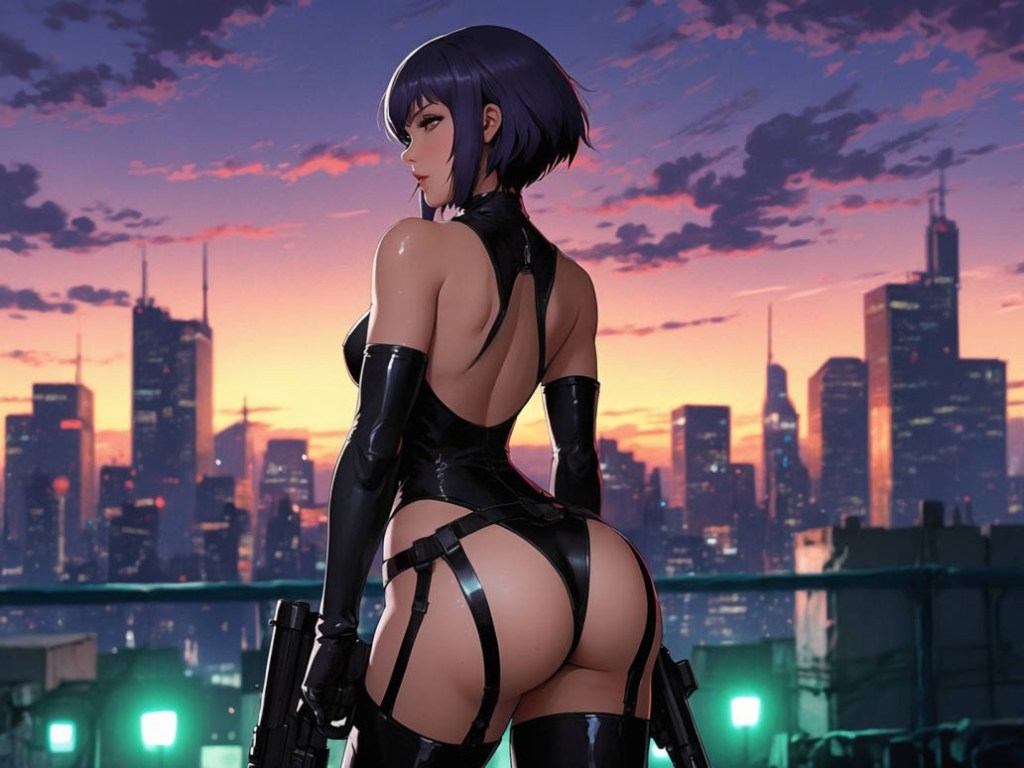
Custom Motoko Ghost in the Shell XXL Mouse Pad – 12 x 22 inches landscape format
The Matrix Connection
It’s impossible to discuss Motoko without mentioning the shadow she cast on Western cinema. When the Wachowskis were developing The Matrix, they cited Ghost in the Shell as one of their biggest inspirations. They even showed Oshii’s film to studio executives, saying, “We want to do that—but in live action.”
From the cascading green code to the existential themes of identity and illusion, Motoko’s DNA runs through The Matrix’s veins. Her cybernetic introspection laid the groundwork for Neo’s awakening, while her digital duality inspired a generation of filmmakers exploring the human-machine divide.
Stand Alone Complex: The Human Side of the Machine
While Oshii’s film painted Motoko as an ethereal, almost alien figure, the 2002 television series Ghost in the Shell: Stand Alone Complex brought her back down to Earth. This Motoko had attitude. She cracked jokes, teased her teammates, and faced the bureaucracy of a high-tech world with sharp wit and sharper reflexes.
Stand Alone Complex expanded her world, introducing the Tachikoma AI tanks—adorable, sentient robots that adored her—and showing her leadership within Section 9. Viewers saw not just the soldier, but the woman: a leader respected by her team and feared by her enemies.
This incarnation of Motoko also leaned into the idea of personal freedom. She was no longer merely questioning what made her human; she was asserting her agency within a system that wanted to control her. Whether outsmarting corrupt politicians or shutting down rogue AIs, Motoko became the ultimate cyber-detective—half-philosopher, half-action hero.
Fans responded with enthusiasm. In Stand Alone Complex, Motoko wasn’t an untouchable cyber-goddess; she was relatable, even if her body was entirely synthetic. Her humor, empathy, and quiet vulnerability made her one of anime’s most complex protagonists.

Latex Motoko Kusanagi XL Mouse Pad – 12 x 18 inches Portrait format
Latex looks good…especially on Anime Latex Mouse Pads
Arise and Rebirth
In 2013, Ghost in the Shell: Arise reimagined Motoko’s origins. This time, she was younger—a brilliant hacker and investigator not yet the commanding Major fans knew. The series explored how she assembled the Section 9 team and earned her rank.
Visually, Arise gave her a new look: shorter purple hair, a more militaristic design, and a tone that blended modern anime style with classic cyberpunk grit. While divisive among longtime fans, Arise highlighted a fresh theme—growth. Motoko wasn’t born as the confident, stoic leader we’d always known. She evolved into it.
By humanizing her beginnings, Arise reaffirmed one of the franchise’s core truths: identity isn’t static. It’s a process—a constant rewriting of the self. For a character who can literally swap bodies, that idea feels particularly fitting.
The Live-Action Experiment
In 2017, Hollywood took its shot at bringing Motoko to the big screen in live action, with Scarlett Johansson playing the Major. The film was visually stunning, capturing the neon dystopia of Oshii’s original with near-photorealistic precision. But it wasn’t without controversy.
Casting a white actress in the role of a Japanese character sparked debates about whitewashing and representation. Fans and critics argued that Motoko’s cultural context—her existence within a Japanese framework of technology, government, and philosophy—was essential to who she is.
Beyond the controversy, the film struggled to capture the spirit of the source material. It simplified Motoko’s existential depth into a story about personal memory and revenge. While Johansson gave a dedicated performance, the film’s version of Motoko felt hollow—a polished shell missing the haunting ghost that made her iconic.
Still, it introduced Ghost in the Shell to a broader global audience and reminded the world how visionary Shirow’s concept truly was.
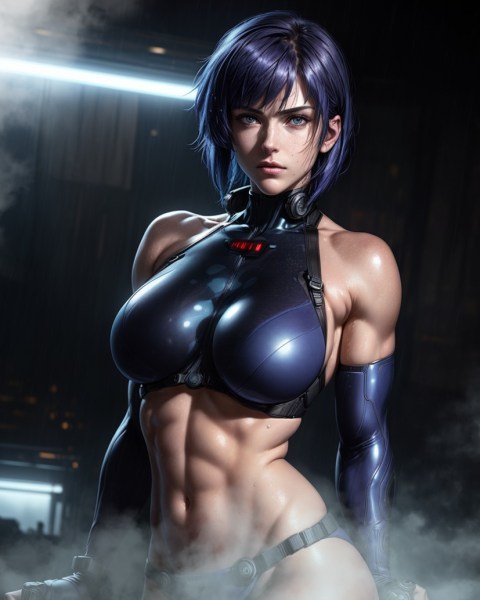
Steamy Motoko Kusanagi XL Mouse Pad – 12 x 18 inches Portrait format
A Symbol Beyond the Screen
Even outside her stories, Motoko Kusanagi has become a symbol—of strength, of autonomy, of female intelligence in a genre often dominated by men. She predates many Western action heroines and arguably out-philosophizes most of them.
Before The Matrix’s Trinity or Ex Machina’s Ava, there was Motoko—wrestling with questions of identity decades before AI became a dinner-table topic. Her character proved that complexity and femininity aren’t opposites. She could be beautiful, commanding, and deeply cerebral all at once.
In Japan, Motoko’s design became iconic in the anime industry: short purple hair, tactical suit, and that piercing, analytical stare. She represents a kind of controlled sensuality—not an object of desire, but a vision of autonomy and confidence. Artists and cosplayers worldwide have adopted her look, not to imitate her, but to channel her spirit.
Her influence stretches far beyond anime. Cyberpunk video games like Deus Ex, Cyberpunk 2077, and Metal Gear Solid echo her themes—questions about body augmentation, identity, and free will. Each owes something to the world Motoko built and the philosophy she embodies.
The Ghost in Modern Culture
As technology continues to blur the line between human and machine, Motoko feels more relevant than ever. In a world of AI companions, neural implants, and virtual identities, her story reads less like science fiction and more like prophecy.
She raises the same questions we’re beginning to ask ourselves:
- If our memories are stored in the cloud, are they still ours?
- When we interact more through screens than faces, what part of our humanity remains intact?
- How much of our identity can be reconstructed before it becomes something new?
In Ghost in the Shell, Motoko’s body is replaceable, but her consciousness—the “ghost”—isn’t. It’s her choices, her awareness, her curiosity that define her. That idea has become a guiding metaphor for the digital age. The more we integrate with technology, the more we must ask what part of ourselves we want to keep purely human.
Why She Endures
So why, decades later, does Motoko Kusanagi still fascinate us?
Because she’s not a fantasy—she’s a mirror. Every era reinterprets her differently, but she always reflects our anxieties about where technology is taking us. In the 1990s, she embodied the thrill and fear of the internet age. In the 2000s, she represented the power of self-definition in a networked world. Today, in an age of AI and digital consciousness, she feels eerily current.
She also endures because she balances contradictions effortlessly. She’s logical yet emotional, human yet machine, heroic yet uncertain. Few characters—animated or otherwise—have captured such a spectrum of humanity inside a synthetic shell.
And unlike many sci-fi protagonists, Motoko’s appeal doesn’t hinge on romance or rebellion alone. She’s not trying to destroy the system—she’s trying to understand it, master it, and navigate it with integrity. In her quiet moments, she’s not mourning her lost humanity but exploring what comes next. That optimism, that refusal to see cybernetics as decay rather than evolution, is what makes her timeless.
The Future of the Major
With each new adaptation, Motoko Kusanagi evolves just as technology does. New audiences will meet her through streaming series, reboots, and virtual media, but the essence will remain the same: the ghost inside the shell, searching for meaning in a world of data.
Whether she’s an AI, a soldier, or a philosopher, Motoko will continue to stand at the frontier of human imagination. Her story isn’t about losing the soul to machines—it’s about finding it again through them.
In the end, Motoko Kusanagi is both prophecy and parable—a reminder that the future of humanity may not lie in resisting the machine, but in understanding how to coexist with it.
Final Thoughts: The Digital Soul
In the ever-expanding realm of cyberpunk fiction, no figure looms larger than the Major. Motoko Kusanagi is more than an anime character—she’s a question, an idea, and perhaps even a glimpse of where humanity is heading.
She reminds us that consciousness, not flesh, defines who we are. And as we step deeper into a world of synthetic intelligence and digital existence, her words echo louder than ever:
“The net is vast and infinite.”
It’s not just a line—it’s a mantra for the 21st century.
And at its heart, somewhere between data and dream, floats the ghost of Motoko Kusanagi—watching, learning, and evolving, just like us.
 Sexy Butt Mouse Pads
